If you own an incorporated business in Calgary or elsewhere in Alberta, whether your shares qualify as small business corporation (SBC) or qualified small business corporation (QSBC) shares can be worth hundreds of thousands of dollars on exit. In 2026, a qualifying share sale can shelter up to $1,275,000 of capital gains per person, and the status also unlocks relief under several anti-avoidance rules.
The catch is that SBC and QSBC status is tested on your balance sheet, at fair market value, over a look-back period. A company that quietly accumulates investments can lose its status without anyone noticing until a buyer is at the table. This article explains what the two terms mean, the key changes affecting business owners in 2026, and five reasons the status matters, with worked examples using 2026 rules and Alberta tax rates.
Connect with our teamWhat’s new for 2026
For 2026, the lifetime capital gains exemption (LCGE) has increased to $1,275,000, potentially allowing eligible business owners to shelter a significant portion of the capital gain when selling qualified small business corporation (QSBC) shares. However, qualifying for the exemption requires meeting specific ownership and asset tests, and alternative minimum tax (AMT) may affect the final tax outcome. Understanding these requirements well before a sale can help business owners protect valuable tax-planning opportunities.
What is a small business corporation?
Generally, if your corporation is a Canadian-controlled private corporation (CCPC) that uses all of its assets in an active business in Canada, your corporation likely qualifies as an SBC. However, if some of your company’s assets aren’t being used to earn active business income, then the corporation may not qualify.
Specifically, to be considered an SBC, you must:
- It is a Canadian-controlled private corporation.
- Use at least 90% of the fair market value (FMV) of the corporation’s assets in an active business that conducts business primarily in Canada
A holding company can also qualify as an SBC if 90% or more of the FMV of its assets are shares or debts in a corporation that is an SBC.
Can you claim the Lifetime capital gain Exemption when Selling a holding company?
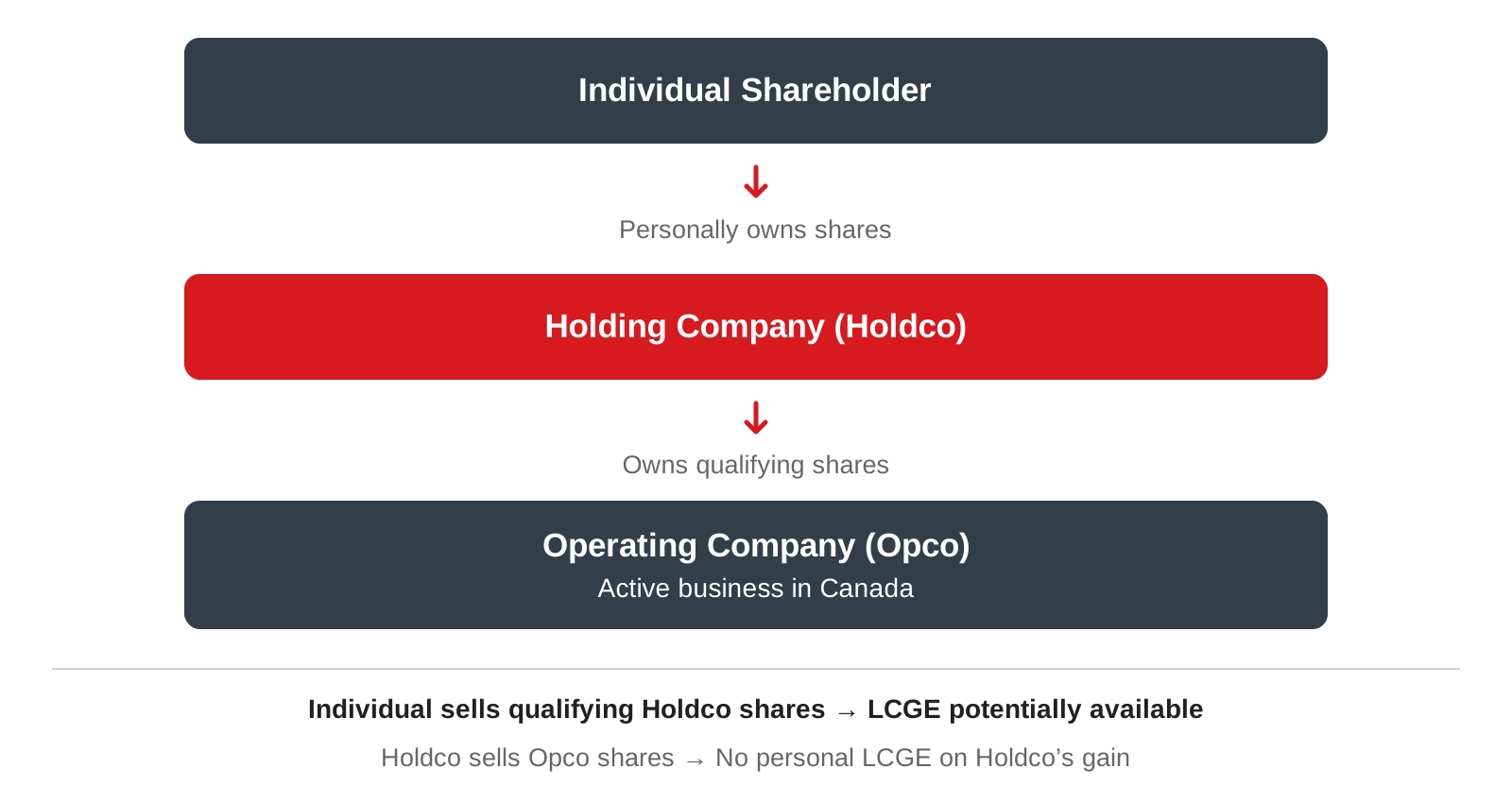
Yes, you may be eligible to claim the lifetime capital gains exemption (LCGE) when selling shares of a holding company, even if the holding company does not operate an active business itself.
For example, if you personally own a holding company (Holdco) that owns shares of an operating company (Opco), selling your Holdco shares may qualify for the LCGE, provided the shares meet the qualified small business corporation (QSBC) requirements.
However, who sells the shares makes a difference. If you personally sell qualifying Holdco shares, you may be eligible for the LCGE. If Holdco sells its shares of Opco, the capital gain is realized by Holdco, and your personal LCGE cannot be claimed against that corporate gain.
Eligibility also depends on the ownership history and asset composition of the holding company and, where applicable, its operating subsidiaries. Surplus investments or cash not required for business operations can affect whether the relevant requirements are met.
If your corporation has excess cash that it invests in marketable securities, these assets would likely not count as being used to earn active business income, which could put your corporation’s SBC status at risk. For example, if a Calgary business has $2 million in active business assets and $400,000 in surplus investments, only approximately 83% of its total asset value would qualify, falling below the generally required 90% threshold. However, cash needed for ongoing operations or future business requirements may still qualify as an active business asset, depending on the circumstances.
Furthermore, since the 90% test is applied to the FMV of assets rather than cost or book value, you may require professional valuation services to ensure you are using the correct values when evaluating the corporation’s SBC status. You should also consider goodwill, which may have a fair market value, but most likely not included on your historical cost balance sheet.
What makes shares QSBC shares?
QSBC status is about the shares, and it is tested at a “determination time,” usually the date you sell. Three tests must all be met:
- SBC test. At the determination time, the corporation is an SBC (the 90% test above).
- Holding period test. The shares of the corporation must be owned by the individual, or a person or partnership related to the individual, throughout the 24 months prior to the particular time.
- Basic asset test. The corporation must be a CCPC throughout the 24 months prior to the particular time and at least 50% of the FMV of its assets must have been used principally in an active business in Canada. “Throughout” means continuously, not on average: if qualifying assets fall to 50% or less at any point in that window, the test is failed.
Example: a sale that arrives too early
Priya incorporated Bow Valley Climate Services Ltd., a Calgary HVAC business, on February 2, 2025, and subscribed for her shares that day. By fall 2026 the business is growing quickly, and a regional competitor offers to buy her shares with a closing date of November 30, 2026.
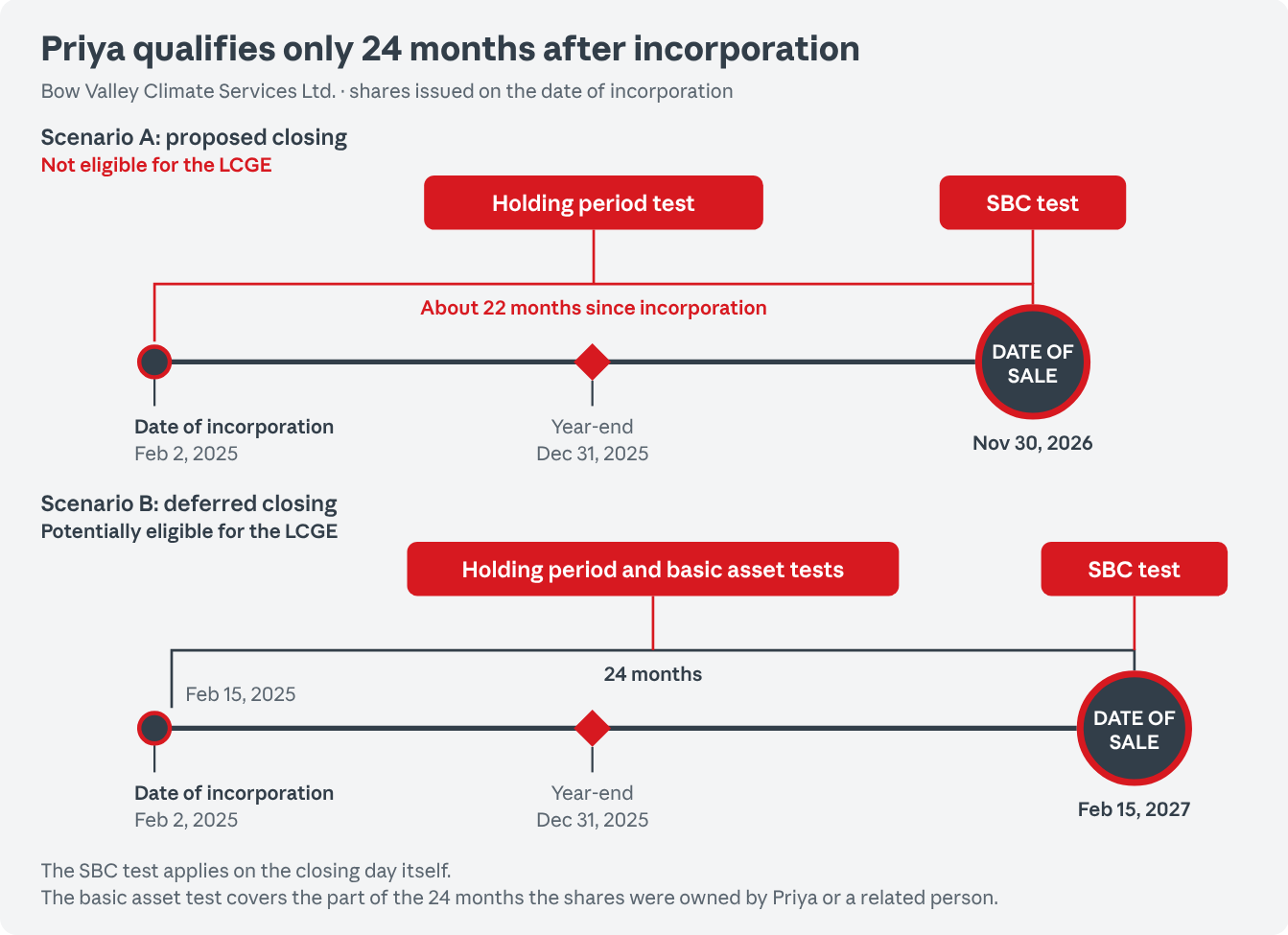
A November 2026 closing falls less than 24 months after Priya incorporated and was issued her shares, so the holding period test is not met. A closing after February 2, 2027 can satisfy that test, provided the other QSBC conditions are also met.
Pushing the closing date back roughly 11 weeks could be the difference between having no access to the LCGE and potentially sheltering up to $1,275,000 of gains. Timing questions like this should be raised before a letter of intent is signed, not after.
Example: a three-month dip below 50%
Northline Fabrication Ltd., a Calgary steel fabricator owned by Tom since 2012, has about $2,000,000 of assets at fair market value. After an unusually strong year, Tom invested $1.1 million of surplus cash in a marketable securities portfolio from January to March 2025. In April 2025, the company paid most of it out to Tom’s holding company as a dividend. A buyer now proposes to close on October 1, 2026.
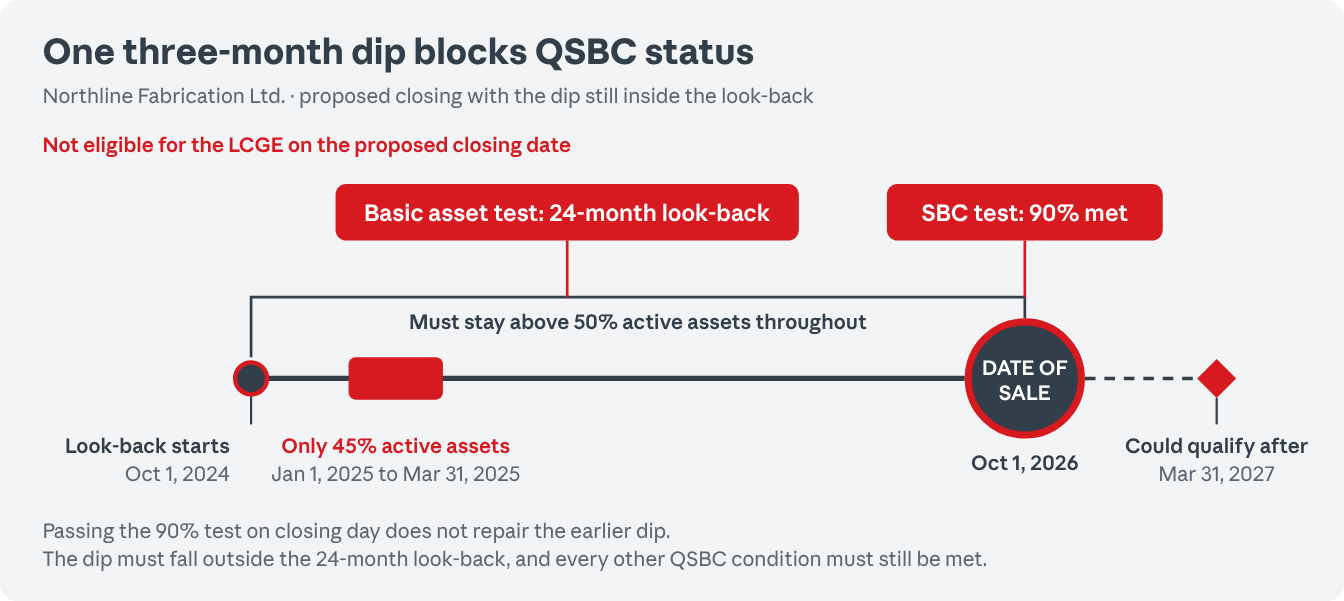
On October 1, 2026, Northline meets the 90% SBC asset test. However, Tom’s shares do not qualify as QSBC shares because the company held only 45% of its asset value in active business assets between January and March 2025, falling below the required 50% threshold during the 24-month period before the sale.
Even though Northline increased its qualifying assets to 90% in April 2025, this does not correct the earlier failure. The QSBC asset test must be satisfied throughout the applicable 24-month period, not just on the sale date. If Tom delays the sale until after March 31, 2027, the three-month period of non-compliance would fall outside the 24-month look-back. His shares could then qualify as QSBC shares, provided all other requirements are met.
Two important points are worth considering. First, not all cash is considered a passive asset. Cash reasonably required for working capital or planned business expenses may qualify as an active business asset, depending on the circumstances. In Northline’s case, the surplus funds were invested in a portfolio to earn investment income, so they did not qualify as active business assets. Second, the QSBC asset test must be met throughout the applicable 24-month period, not just at year-end. A corporation may meet the requirements on its year-end balance sheet but fail them during the year. Regularly reviewing the corporation’s assets and monitoring surplus cash and investments can help owners identify potential issues before they affect QSBC eligibility.
Reason I: The lifetime capital gains exemption
The LCGE lets a Canadian-resident individual shelter capital gains on QSBC shares (and qualified farm or fishing property) up to a lifetime limit. That limit is $1,275,000 for 2026 dispositions and is indexed to inflation each year from now on. Because only half of a capital gain is taxable, the deduction you actually claim on line 25400 of your return is half the exemption: $637,500 in 2026.
Example: selling a Calgary landscaping company in 2026
Marcus owns all the shares of Foothills Landscape Inc., which he incorporated with $100 in 2014. In October 2026 a buyer pays $2,000,000 for his shares. For simplicity, we apply Alberta’s 2026 top combined personal rate of 48% to the taxable amount.
Using this simplified 48% marginal-rate assumption, the exemption reduces the illustrated tax by about $306,000. Marcus’s actual saving will depend on his other income, deductions, credits, and cumulative net investment loss (CNIL) balance. If his spouse had owned half the shares for the past 24 months and had her own unused exemption, the combined saving could be far larger.
Don’t forget the alternative minimum tax
Although the lifetime capital gains exemption can shelter a significant capital gain from regular income tax, some business owners may still be subject to alternative minimum tax. AMT is a separate tax calculation that limits the benefit of certain tax exemptions and deductions. When selling QSBC shares, a business owner may have to pay AMT even if part of the capital gain is sheltered by the LCGE.
However, AMT does not automatically apply to every business owner claiming the LCGE. The outcome depends on the individual’s overall income, deductions, tax credits, and other circumstances. AMT paid may generally be recovered over the following seven years if sufficient regular tax becomes payable. For this reason, business owners should assess potential AMT exposure before selling their shares and claiming the LCGE.
These considerations highlight the importance of planning well before selling a business. Strategies such as corporate purification or restructuring may help business owners maintain QSBC eligibility and maximize the benefits of the lifetime capital gains exemption. However, professional tax advice is essential when considering these strategies, as the timing of a transaction, the corporation’s assets, and potential alternative minimum tax (AMT) implications can significantly affect the tax outcome.
Locking in the exemption and sharing it with family
You don’t have to wait for a sale to use the LCGE. If your shares qualify today but might not later, for example because you plan to accumulate investments in the company, you can “crystallize” the exemption. This typically involves an internal reorganization or a transfer of Opco shares to a holding company, electing a price that triggers a gain up to your available exemption. The shares take on a higher tax cost, which reduces the gain on a future sale even if QSBC status is later lost. Crystallization gains now count toward AMT in the same way as a sale, so the transaction should be modelled first.
The exemption belongs to each individual. Where family members own qualifying shares directly, or where a properly structured personal trust realizes a QSBC gain and validly allocates and designates it to eligible individual beneficiaries, several people may each use their own available LCGE. In theory, a family of four could shelter up to $5.1 million of gains at 2026 limits, subject to each person’s unused exemption, CNIL balance, and other restrictions. Ownership must be put in place well before a sale because of the 24-month holding tests, and structures that include family members who are not active in the business need careful review under the TOSI rules below.
Reason II: Keeping share-sale gains out of the tax on split income
Maintaining your company’s qualified small business corporation (QSBC) status is especially important when planning for your family’s future or preparing to sell the business you have worked hard to build. The tax on split income (TOSI) rules can create significant and unexpected tax consequences, particularly when family members own shares but are not actively involved in the business. Seeking professional tax advice can help you navigate these complex rules, protect your family’s financial interests, and explore valuable tax-planning opportunities.
When TOSI applies, the affected income is generally taxed at the highest personal marginal tax rate, which is 48% in Alberta in 2026, with limited deductions and tax credits available. However, an important exception generally applies to capital gains from the sale of QSBC shares, except for certain non-arm’s-length dispositions involving minors. Maintaining QSBC status can therefore help protect qualifying share-sale gains from the higher tax treatment imposed by TOSI.
Importantly, you do not have to claim the lifetime capital gains exemption (LCGE) to benefit from this exception. Even if you or an eligible family member have already used the available LCGE, qualifying QSBC share-sale gains may still receive regular capital gains treatment, creating additional flexibility for family tax planning and business succession.
Reason III: Avoiding the corporate attribution rule
The corporate attribution rule can apply when you transfer or lend property to a corporation and one of the main purposes is to benefit a spouse, common-law partner, or minor child or niece or nephew who owns shares. Estate freezes and adding family members as shareholders are common triggers. When it applies, you must report deemed interest at the CRA prescribed rate on the amount transferred or lent. That amount is reduced only by interest you actually receive and grossed-up dividends on the shares you took back. The corporation gets no matching deduction, so the same economic value is effectively taxed twice.
One of the conditions for corporate attribution under subsection 74.4(2) is that the corporation is not an SBC during the relevant period. Keeping SBC status is therefore a practical way to stay clear of it.
Example: an estate freeze in 2026
Daniel owns a Calgary engineering consultancy worth $1,500,000. In 2026 he completes an estate freeze: he exchanges his common shares for $1,500,000 of fixed-value preferred shares, and a family trust for his spouse and two young children subscribes for new common shares. While the company stays an SBC, corporate attribution does not apply.
Now suppose the company sells a division and parks the proceeds in a long-term bond portfolio, dropping below the 90% threshold for a year. Daniel would face a deemed benefit of $1,500,000 × 3% (the prescribed rate for every quarter of 2026) = $45,000, less any dividends on his preferred shares. At Alberta’s 48% top rate, that is about $21,600 of personal tax on income he never received. Because the prescribed rate is set quarterly, the cost rises automatically if rates climb.
Reason IV: Turning a failed investment to an ABIL
If you have invested in a private company by purchasing shares or lending money, but the investment does not work out as expected, you may be able to claim a tax deduction for part of your loss. Normally, this is treated as an allowable capital loss, which can only be deducted against taxable capital gains. If you have no capital gains, you may have to wait before receiving any tax benefit.
However, if your investment was in a small business corporation (SBC) and the other eligibility requirements are met, the loss may qualify as an allowable business investment loss (ABIL). Unlike an ordinary allowable capital loss, an ABIL offers greater flexibility and may allow you to benefit from the tax deduction much sooner.
An ABIL can be deducted against any source of income, including employment income, business income, dividends, and rental income. If you cannot fully use the deduction in the current year, the unused amount can generally be carried back three years or forward ten years to offset income from any source. After that period, any remaining unused amount becomes a net capital loss, which can only be applied against taxable capital gains. This makes maintaining SBC status particularly valuable, as it may help investors recover some of the financial impact of an unsuccessful investment through tax savings when they need them most.
Example: backing a friend’s startup
In 2023, Leah, a Calgary physiotherapist earning about $240,000 a year, invested $150,000 in shares of a friend’s Edmonton food-tech startup. The company qualified as an SBC but went bankrupt in 2026.
- As an ABIL: $75,000 (half of $150,000) is deducted against her 2026 professional income. At her 2026 marginal rate, that is roughly $30,000 of tax savings this year.
- As an ordinary capital loss: the same $75,000 could only offset taxable capital gains. With no gains, Leah would carry the loss forward and get no benefit in 2026.
If you invest in or lend to private companies, confirming their SBC status during the 12 months before the loss matters as much as it does for your own company.
Reason V: More succession options
Two newer succession routes are only open to owners whose companies meet QSBC-style tests.
- Selling to the next generation. Historically, selling your shares to a corporation owned by your children could turn what should be a capital gain into a taxable dividend. Rules in force since January 1, 2024 allow a genuine intergenerational transfer to be taxed as a capital gain, eligible for the LCGE, if strict conditions are met. The shares must be QSBC shares (or shares of a family farm or fishing corporation). The parents must also transfer control and, over a set period, their management role, under either a three-year immediate-transfer framework or a five-to-ten-year gradual-transfer framework.
- Selling to your employees. If you are planning to retire or sell your business but do not have a family member to take over, selling to your employees through an employee ownership trust (EOT) may be an attractive option. A qualifying sale can shelter up to $10 million in capital gains, shared among eligible selling owners. To qualify, the business must meet specific ownership and active business asset requirements, and the seller must generally have been actively involved in the business for at least 24 months. Professional corporations are excluded from this special exemption, although their shareholders may still qualify for the regular lifetime capital gains exemption. The EOT exemption, originally intended to be temporary, was made permanent in 2026. Because these transactions involve strict eligibility requirements and potential tax consequences if certain conditions are not maintained after the sale, professional tax advice is important before proceeding.
In both cases, the same balance sheet discipline that protects QSBC status keeps these options open.
How to keep your status
Most companies lose SBC or QSBC status gradually, through retained profits that are never needed in the business. The fix starts with knowing what is on your balance sheet at fair market value and why.
Assets that commonly put status at risk:
- Surplus cash and term deposits beyond what the business needs for working capital, planned equipment purchases, debt repayment, or a supplier or bonding requirement
- Investment portfolios, including GICs, bonds, and marketable securities
- Real estate rented to third parties, such as the unused floor of your shop leased to an unrelated tenant
- Equipment leased to unrelated businesses when leasing is not your line of business
- Loans to shareholders or family that are not connected to operations
- Vehicles and other assets used personally more than they are used in the business
Cash is the grey area, and the answer depends on the facts. Cash reasonably required for current or reasonably anticipated business needs may be treated as an active asset. Surplus cash held mainly for investment is more likely to be treated as passive. Contemporaneous budgets, capital plans, and board minutes can help support a business purpose, but documentation alone will not turn surplus cash into an active asset.
If your company is close to the line, common “purification” steps include paying down debt, investing in equipment or inventory, paying taxable dividends, and moving surplus to a holding company through tax-free intercorporate dividends. Each option has trade-offs. Safe income limits, refundable tax balances, and the 24-month look-back all affect which route works. Purifying just before closing can help you pass the 90% SBC test on the sale date, but it cannot repair an earlier period when qualifying assets were 50% or less. That period has to fall outside the 24-month look-back. Because the basic asset test can look back as far as 24 months, purification should begin well before any sale discussions.
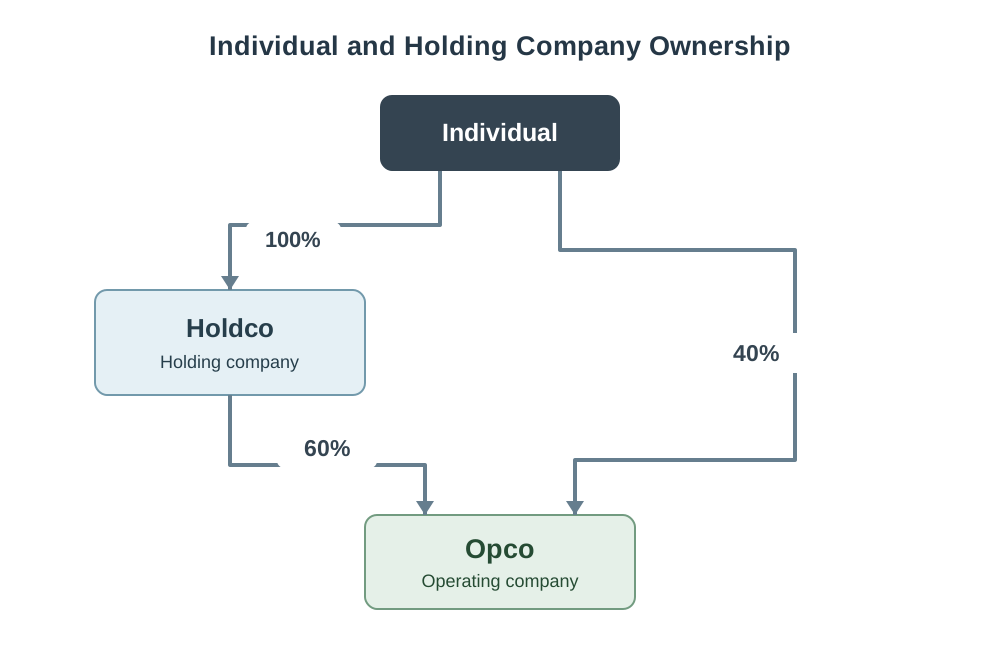
A holding company can be an effective tool for maintaining QSBC status. For example, an individual may own 40% of an operating company directly and the remaining 60% through a wholly owned holding company. With proper tax planning, excess cash may be distributed from the operating company to the holding company, helping preserve the operating company’s active business asset ratio. The individual may qualify for the lifetime capital gains exemption (LCGE) when selling their directly owned QSBC shares, while the holding company cannot claim the LCGE on its share-sale gain. The ownership structure and tax implications of transferring funds should be carefully reviewed before implementing this strategy.
SBC and QSBC status should be monitored well before a business sale is on the horizon. Reviewing your corporation’s assets at fair market value, managing surplus cash and investments, monitoring the 24-month QSBC tests, and considering purification early can help preserve access to the lifetime capital gains exemption and keep valuable tax and succession planning options available.
Know what’s on your balance sheet and plan ahead with ValueNode Accounting
If your corporation does not currently meet the SBC or QSBC requirements, reviewing your balance sheet and identifying which assets may be affecting its status is a good starting point. If surplus cash is an issue, options such as paying down liabilities, investing in business assets, paying dividends, or moving funds to a holding company may help improve your position.
Helping Calgary business owners make informed financial and tax decisions is a priority at ValueNode Accounting. When tax planning is done in advance, it can help guide decisions around cash, investments, corporate structure, and succession while preserving more options for the future. Our corporate tax and fractional CFO advisory services bring these considerations together as part of your broader business planning.


